The AI that fixes outages by itself — Patent pending
RRELIORASRENIX
Talk to us ↗
Free now Early adopters: become a Design Partner — 88 of 100 places left 

Use cases

The incidents your team knows by heart.

Most on-call work isn’t new. It’s the same handful of failures, again and again. These are the six Srenix takes off your plate.

01 · Certificates

“The certificate expired over the weekend.”

86% of companies had at least one outage from an expired or mismanaged certificate last year. And public certificate lifetimes are shrinking: 200 days from March 2026, 47 days by 2029. Keyfactor, 2025

  1. Spots certificates that are expiring, too weak, or stuck in renewal, days before anything breaks.
  2. Clears the stuck request and has cert-manager issue a new certificate.
  3. Checks the new certificate is the one actually being served, then closes the finding.

Fixes it on its own, within the policy you set

Swipe to follow the story →
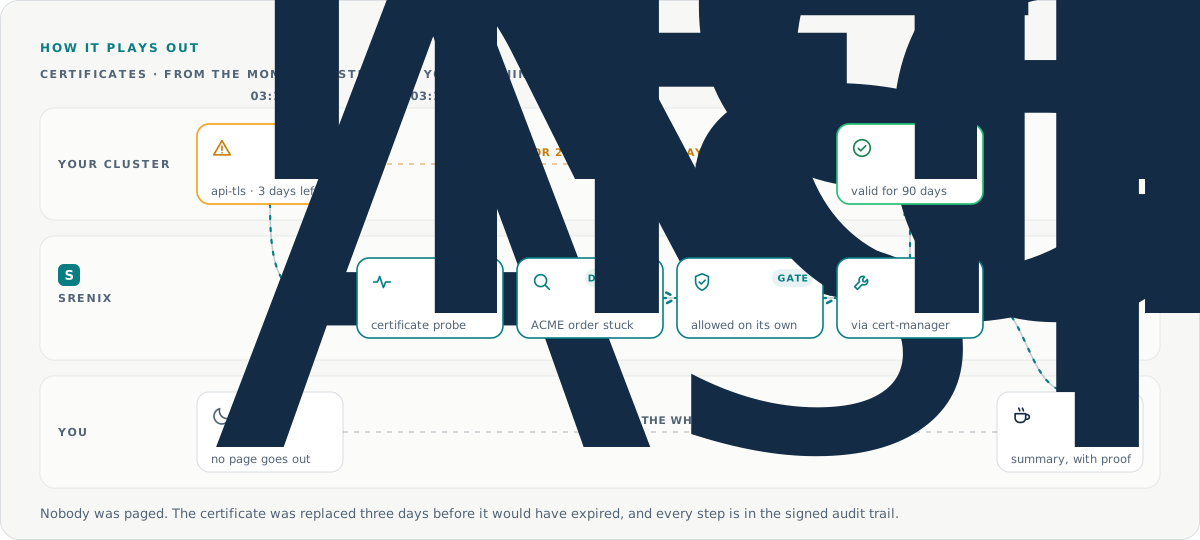
The story, start to finish. 03:14: Renewal stuck (api-tls · 3 days left) while you sleep. Srenix notices it, finds why (ACME order stuck), checks your rules (allowed on its own), reissues it (via cert-manager): new cert served, valid for 90 days. 08:30: you read the recap. Nobody was paged. The certificate was replaced three days before it would have expired, and every step is in the signed audit trail.
79%of production issues start with a recent changeKomodor, 2025
~40 minmedian time just to notice a high-impact outageKomodor, 2025
~70%of SREs say on-call stress drives burnoutCatchpoint, 2025

02 · Crash loops

“The pod keeps restarting and nobody knows why.”

CrashLoopBackOff and OOMKilled are among the most common failures in Kubernetes. One representative production cluster logged 40 to 50 out-of-memory kills an hour. Cast AI, Kubernetes troubleshooting hub

  1. Reads the exit code, the restarts and the real memory use to find why it keeps crashing.
  2. Raises the memory limit within the bounds you set, then restarts the rollout.
  3. Watches the pods stay up before it calls it fixed.

Fixes it on its own, within the policy you set

Swipe to follow the story →
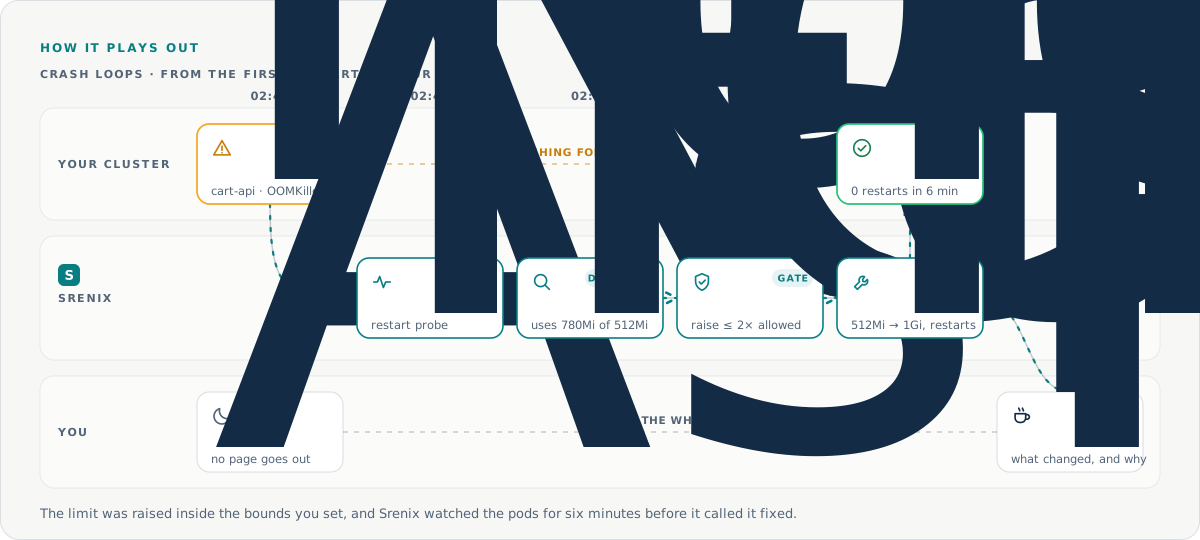
The story, start to finish. 02:41: Pod crash-loops (cart-api · OOMKilled) while you sleep. Srenix notices it, finds why (uses 780Mi of 512Mi), checks your rules (raise ≤ 2× allowed), raises the limit (512Mi → 1Gi, restarts): pods stay up, 0 restarts in 6 min. 09:05: you read the recap. The limit was raised inside the bounds you set, and Srenix watched the pods for six minutes before it called it fixed.
79%of production issues start with a recent changeKomodor, 2025
~40 minmedian time just to notice a high-impact outageKomodor, 2025
~70%of SREs say on-call stress drives burnoutCatchpoint, 2025

03 · Bad deploys

“It was fine until the last deploy.”

79% of production issues start with a recent change. For the outages that matter most, it takes a median of nearly 40 minutes just to notice. Komodor Enterprise Kubernetes Report, 2025

  1. Links the errors to the change that caused them: which rollout, which setting, and when.
  2. Proposes the rollback and asks you in Slack. Nothing runs until you approve.
  3. Confirms the error rate is back to normal after the rollback.

Fixes it once you approve, in one tap from Slack

Swipe to follow the story →
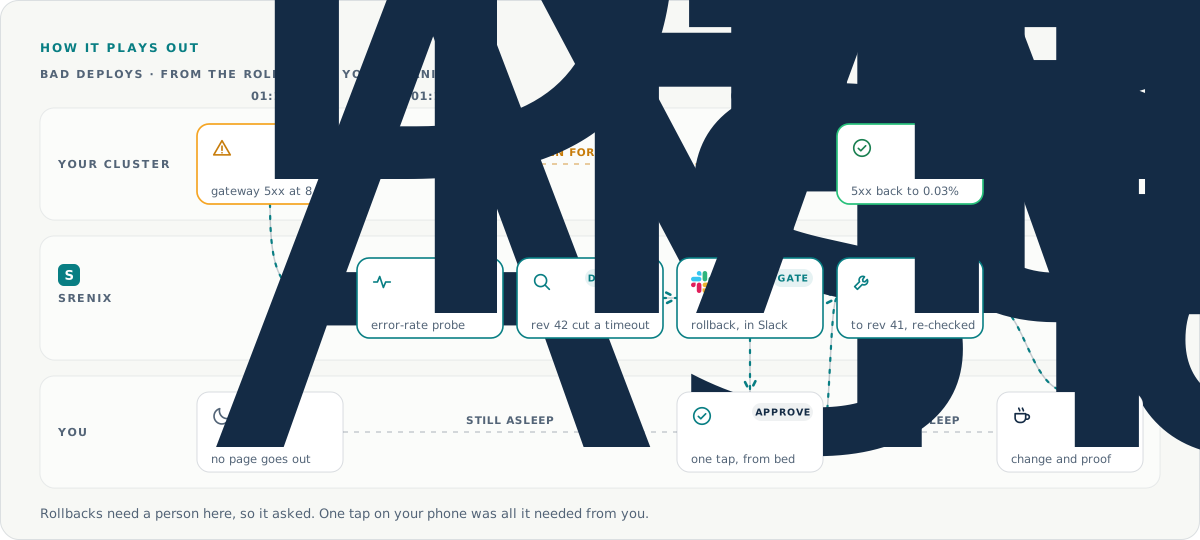
The story, start to finish. 01:12: Deploy breaks it (gateway 5xx at 8.2%) while you sleep. Srenix notices it, finds why (rev 42 cut a timeout), asks you in Slack and you approve with one tap, rolls it back (to rev 41, re-checked): errors gone, 5xx back to 0.03%. 08:40: you read the recap. Rollbacks need a person here, so it asked. One tap on your phone was all it needed from you.
79%of production issues start with a recent changeKomodor, 2025
~40 minmedian time just to notice a high-impact outageKomodor, 2025
~70%of SREs say on-call stress drives burnoutCatchpoint, 2025

04 · Secrets

“Someone rotated a secret and the service fell over.”

A bad config or a missing secret is the first cause on any CrashLoopBackOff checklist, and it breaks at startup, when the pod needs it most. Cast AI, CrashLoopBackOff causes

  1. Finds the exact Secret, the missing key, and the Vault path it should come from.
  2. Re-syncs the key from your secret store, so the value comes from where it always lives.
  3. Checks every pod starts cleanly with the key back in place.

Fixes it on its own, within the policy you set

Swipe to follow the story →
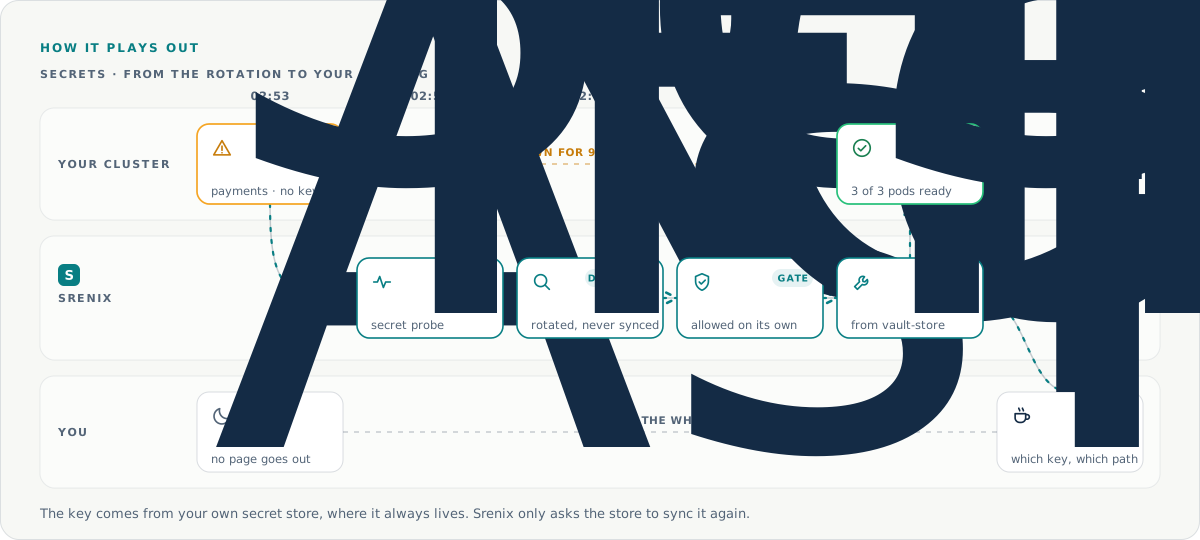
The story, start to finish. 02:53: Service down (payments · no key) while you sleep. Srenix notices it, finds why (rotated, never synced), checks your rules (allowed on its own), re-syncs the key (from vault-store): service back up, 3 of 3 pods ready. 08:15: you read the recap. The key comes from your own secret store, where it always lives. Srenix only asks the store to sync it again.
79%of production issues start with a recent changeKomodor, 2025
~40 minmedian time just to notice a high-impact outageKomodor, 2025
~70%of SREs say on-call stress drives burnoutCatchpoint, 2025

05 · Stuck jobs

“The nightly job has been stuck since 2am.”

Frozen jobs, pods stuck terminating and rollouts that never finish rarely page anyone, until something downstream backs up.

  1. Notices jobs that stopped making progress and pods stuck on nodes that have gone away.
  2. Uses a short list of safe, undoable fixes: remove the stuck pod, stop the frozen job, restart the stuck ReplicaSet.
  3. Keeps checking until the job has actually finished.

Fixes it on its own, within the policy you set

Swipe to follow the story →
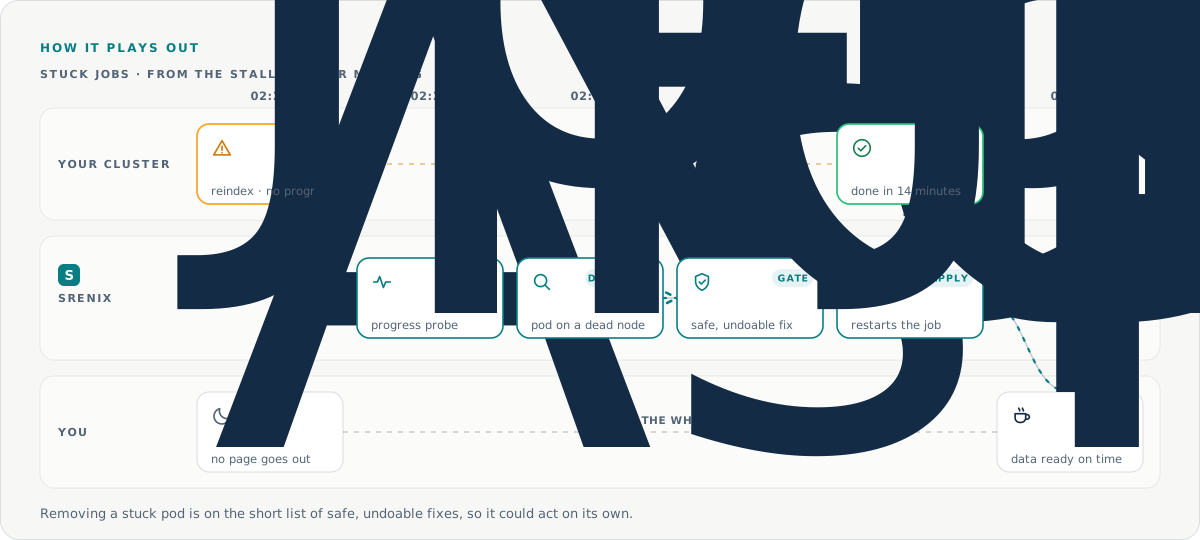
The story, start to finish. 02:20: Job stops moving (reindex · no progress) while you sleep. Srenix notices it, finds why (pod on a dead node), checks your rules (safe, undoable fix), clears the pod (restarts the job): job finishes, done in 14 minutes. 08:10: you read the recap. Removing a stuck pod is on the short list of safe, undoable fixes, so it could act on its own.
79%of production issues start with a recent changeKomodor, 2025
~40 minmedian time just to notice a high-impact outageKomodor, 2025
~70%of SREs say on-call stress drives burnoutCatchpoint, 2025

06 · Full disks

“The disk filled up at 3am. Again.”

Nearly 70% of SREs say on-call stress is driving burnout and people leaving. Time lost to repetitive toil rose to 30%, the first rise in five years. Catchpoint SRE Report, 2025

  1. Sees disk pressure building before the node starts evicting pods.
  2. Proposes expanding the volume. It asks first, because it costs money.
  3. Confirms writes and scrapes are healthy again.

Fixes it once you approve, in one tap from Slack

Swipe to follow the story →
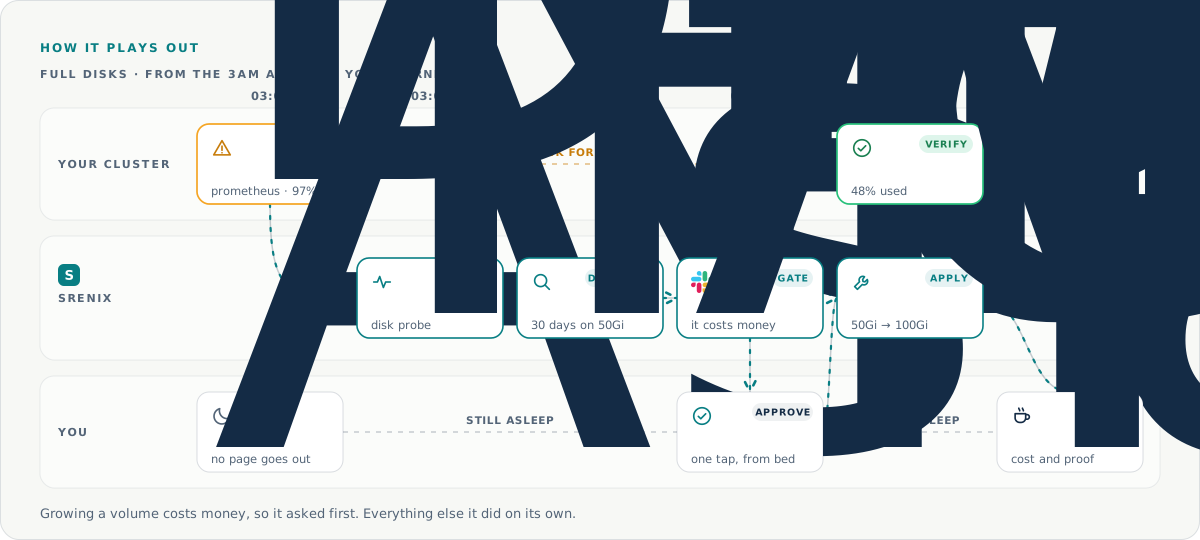
The story, start to finish. 03:02: Disk nearly full (prometheus · 97%) while you sleep. Srenix notices it, finds why (30 days on 50Gi), asks you in Slack and you approve with one tap, grows the volume (50Gi → 100Gi): writes healthy, 48% used. 08:25: you read the recap. Growing a volume costs money, so it asked first. Everything else it did on its own.
79%of production issues start with a recent changeKomodor, 2025
~40 minmedian time just to notice a high-impact outageKomodor, 2025
~70%of SREs say on-call stress drives burnoutCatchpoint, 2025

Which of these woke you up last month?

We’ll show you Srenix handling it on your own stack.